
When to replace a commercial boiler
Age is the weakest of the four reasons to replace a commercial boiler. Parts availability, the efficiency gap, and whether the boiler still matches how the building is run all matter more.
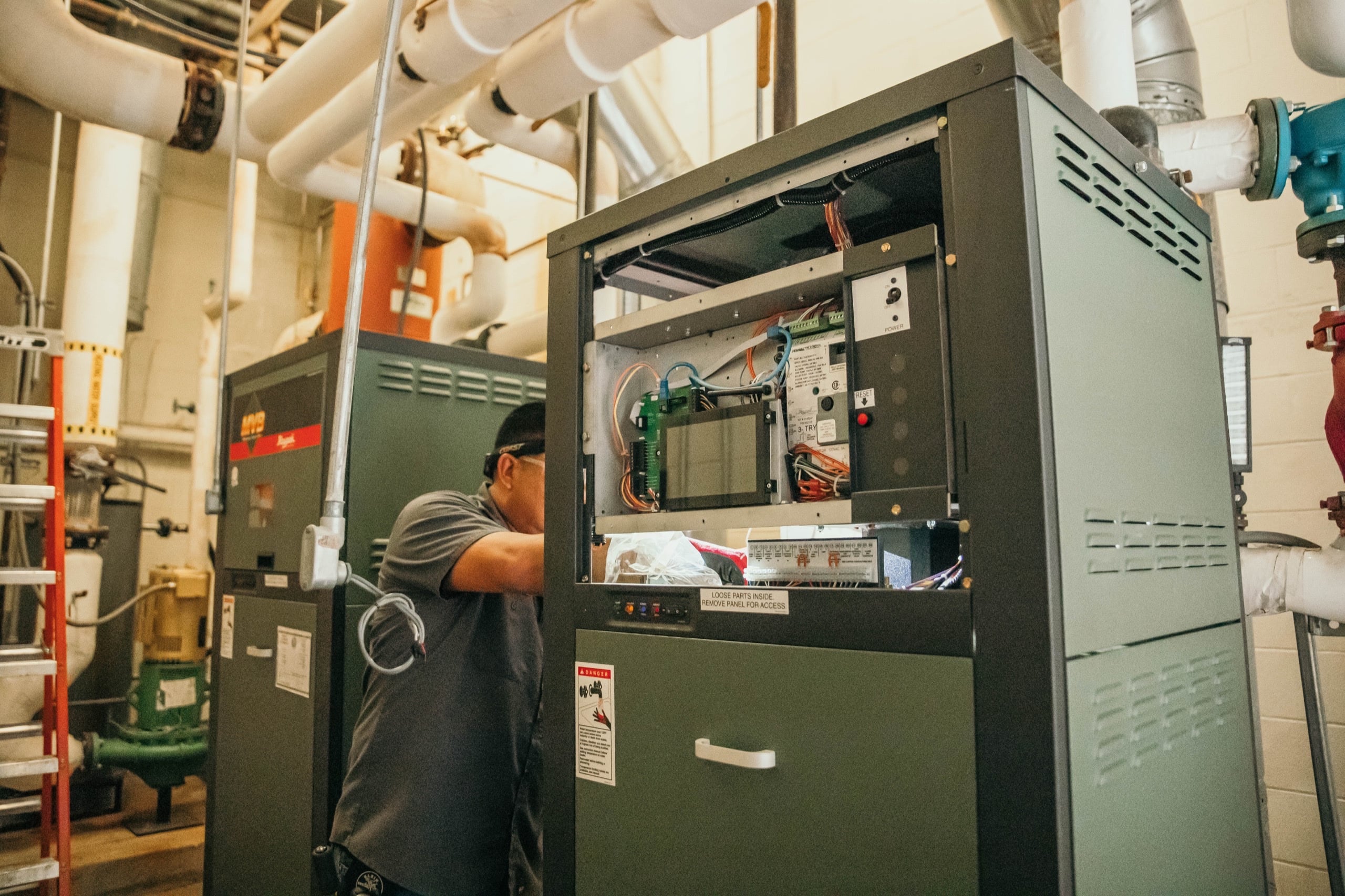
First-hand insights from the people installing, servicing, and designing boiler systems since 1977.
Replace a commercial boiler when the repair costs more than the replacement, when the manufacturer has stopped making parts for it, when the building has outgrown it, or when the way you run it no longer matches what it was built to do. Age on its own is the weakest reason of the four.
The number everybody quotes is 15 to 20 years. We quote it too when somebody asks how long a new boiler will last. It is an average, and almost nothing is average.
15 to 20 years is a sales answer, not a lifespan
We still service boilers that were installed in 1990. At the other end of the range, we have seen a steam boiler with steel fire tubes fail in seven days, because the customer was feeding it water pumped out of a pond a couple of fields away, full of sand and dirt from the first day it ran.
Both of those are commercial boilers. The difference between seven days and 35 years is not the badge on the front.
With good water, real maintenance and combustion kept in tune, 35 to 40 years out of a fin tube boiler is normal. A steam boiler of fire tube design on good water will outlast the people who installed it.
Water quality decides more than the material does
Material matters a little. Water matters far more.
Bad water scales a boiler quickly, and scale is what kills it. Water flow does the same damage more quietly. If flow drops just enough to keep the flow switch happy but not enough for the design, copper tubes, copper nickel tubes and steel tubes all scale faster and fail sooner. The boiler keeps running. It is just running itself into the ground.
Premature failure usually traces back to one of four things: no maintenance at all, hard water, an installation that was wrong from the start, or too much or too little gas.
That is why the first thing we look at is not the boiler. It is the application. Was it installed correctly the first time, and if not, what will it take to put it right. Then, what is failing now, and why.
Texas water is not one thing
Where you are in the state changes the math, and it changes it more than most owners expect.
- San Antonio has the hardest water in Texas, averaging around 18 grains per gallon. That is very hard water and it takes years off a boiler.
- College Station is close to zero.
- Houston depends on which part of the city you are in and where the water comes from. It ranges roughly between three and ten. Ten is on the harder side, three is not worth worrying about, and the middle is where a softener starts to earn its place.
When we look at a boiler somebody is thinking about replacing, we run a water hardness test on site at no charge. If the water is hard, we put a softener in front of the new boiler. Installing a new boiler on the water that killed the last one is buying the same problem twice.
The four reasons we recommend replacement
- The repair costs more than the replacement. The obvious one, and the one owners expect.
- Parts have stopped being made. If the boiler is over 10 years old and the manufacturer has gone out of business or dropped support for the model, there may be no option. This one catches people by surprise, because the boiler is perfectly serviceable right up until the day the part you need no longer exists.
- The efficiency gap got too wide. In the right application there are boilers running at 99 percent efficiency. If yours is running at 82 percent, that gap is paid for every month on the gas bill.
- The way you run it changed. This is the one owners almost never see coming. Buildings run lower water temperatures now and use boilers through the summer for reheat. If your return water comes back at 110 degrees and the boiler was never a condensing boiler, it is now running in a condensing application. It will gum up and fail early, and nothing about that failure will look like anybody's fault.
Whoever changes how a plant is operated should be asking the questions that go with it. Is the boiler running year round now rather than only in winter? Did the operating temperatures change? Did somebody add tempering valves since it went in? Those answers decide whether the boiler you have is still the right boiler.
What it looks like before it fails
You do not need to be a boiler technician to spot a boiler in trouble. These are the signs we look for:
- The high limit has to be reset.
- Stack temperature is suddenly running higher than it used to.
- The boiler is not keeping up with demand.
- It keeps going down. Somebody resets it, it runs a few hours, and it goes down again.
- It has started leaking.
- It is a fin tube boiler at around 15 years old. That is not a failure. It is a reason to start budgeting.
The pattern worth paying attention to is the reset. When the maintenance person on site is hitting the reset button and the boiler runs a few hours before dropping out again, that is not a boiler that needs resetting. That is a boiler telling you something, and nobody is listening.
Most owners do not know what they have
When we surveyed apartment complexes across the Houston area, almost none of the owners knew the age of their boiler or the brand on the front of it. In some cases they did not know they had two, and that one of them had been down for two years. Apartment complexes in particular run to failure. As long as there is hot water nothing gets looked at, and then one morning there is no hot water and it is an emergency.
The same pattern shows up on the phone. When a boiler goes down most people do not know who to call, so they call a plumbing company. Commercial boilers have gotten more sophisticated, and a plumber who cannot work on one has a single recommendation available, which is to replace it. That is not always wrong. It is just not an assessment. In our experience the caller's theory about what has failed turns out to be wrong close to 98 percent of the time.
If you cannot afford downtime during a replacement, we have rentals
Most buildings cannot go cold while a boiler is replaced. An apartment complex, a hotel, a hospital, a school: the hot water has to stay on while the work happens. There are two ways to keep a building running through a replacement, and which one fits comes down to how your system was designed.
If the system has more than one boiler and some room to spare, we can phase the work. We take one unit out at a time and the others carry the building while the replacement goes in. Nothing gets trucked in, and nobody notices. How far we can push that depends on how much spare capacity the original design left you.
If there is only one boiler, or the rest of the system cannot carry the load on its own, that is where a boiler rental comes in. We bring in a temporary unit, portable, skid-mounted or trailer-mounted, out of our Texas warehouses. It carries the building while the new boiler is ordered, delivered and installed.
How fast a rental goes live depends on what we are tying into. On an apartment complex we are usually there within a couple of hours and working on the hookup, because tapping into a two inch line is straightforward. A large industrial tie-in is a different job. The unit may come from out of state on a trailer and take days to connect through eight inch pipe running two hundred feet. Domestic hot water and heating boilers are usually back up and running within 24 hours, sometimes much faster.
Either way, the cheapest version of this is the one you saw coming. A common size in a standard configuration can move fast. Large units, custom configurations, a specific burner, a long list of controls: those carry the long lead times, and those are the ones worth ordering before the boiler quits on you.
If you are calling about an emergency, send photographs straight away. The fastest thing you can do to speed us up is let us see what we are dealing with before we load the truck.
What Texas requires when you replace
Replacing a commercial boiler in Texas is not only a purchase. When a new boiler goes in, a boiler installation form has to be filed with the state. The state then sends an inspector to look at the installation and issues an operator's permit to the owner, and keeping that permit valid is the owner's responsibility from then on.
TDLR also requires a carbon monoxide monitor on any boiler over 199,999 BTU input, which shuts the boiler down if carbon monoxide passes 200 parts per million. We supply one with every new boiler that goes out.
Emissions are a separate question and usually sit with the environmental regulator rather than TDLR. On some sites the NOx limit decides which burner you can use, and whether 30 parts per million is acceptable or you need a sub 9 burner. That affects what you can install. It does not affect when you should replace.
What we will not do
We do not replace what does not need replacing, and we avoid selling parts without a professional diagnosis behind them. Ordering a blower motor, a gas valve, a hot surface igniter, a flame rod and an airflow switch for one boiler, because nobody has established which part actually failed, moves a lot of parts. It is not a repair. The fault is still there.
Tell us what the boiler is doing and we will tell you what it will take to fix it, and nothing beyond that. Sometimes that answer is a replacement. Often it is not.
Common questions
How long should a commercial boiler last?
15 to 20 years is the usual answer and it is an average rather than a prediction. With good water quality, consistent maintenance and combustion kept in tune, 35 to 40 years out of a fin tube boiler is achievable. On bad water, boilers have failed in days.
Should a 20 year old boiler be replaced?
Not automatically. Age alone does not decide it. A 20 year old boiler on good water that still meets the building's load and still has parts available can keep running. A 10 year old boiler whose manufacturer no longer makes parts for it may have to go.
Is it cheaper to repair or replace a boiler?
Repair is cheaper until the repair approaches the cost of replacement, or until the parts stop existing. The three things that move the answer toward replacement are parts availability, the efficiency gap against current equipment, and whether the boiler still matches how the building is run today.
How do I know when a boiler needs replacing?
Watch for the high limit needing resets, stack temperature climbing, the boiler failing to keep up with demand, repeated shutdowns between resets, and any new leak. A fin tube boiler at around 15 years is worth budgeting for even while it is running normally.
How much does it cost to replace a commercial boiler?
An average price would mislead more than it would help, because the equipment is often the smaller half of the number. Removing the old unit and installing the new one, venting, gas supply, water treatment and downtime can all affect the total. We price the whole job rather than the equipment.
Can a boiler last 40 years?
Yes. We still service boilers installed in 1990. It takes good water, real maintenance, and an application that has not changed out from under the boiler.
Talk to us before it fails
If your boiler is showing any of the signs above, or it is a fin tube unit coming up on 15 years, a conversation now costs nothing, and it avoids an emergency at the time you least want one.


